
BLOG
Tabernanthalog Explained: What It Is, Why It Matters, and What Comes Next
Aug
From Plant Alkaloids to Modern Chemistry: Where tabernanthalog Fits in Today’s Neuropsychiatric Conversation
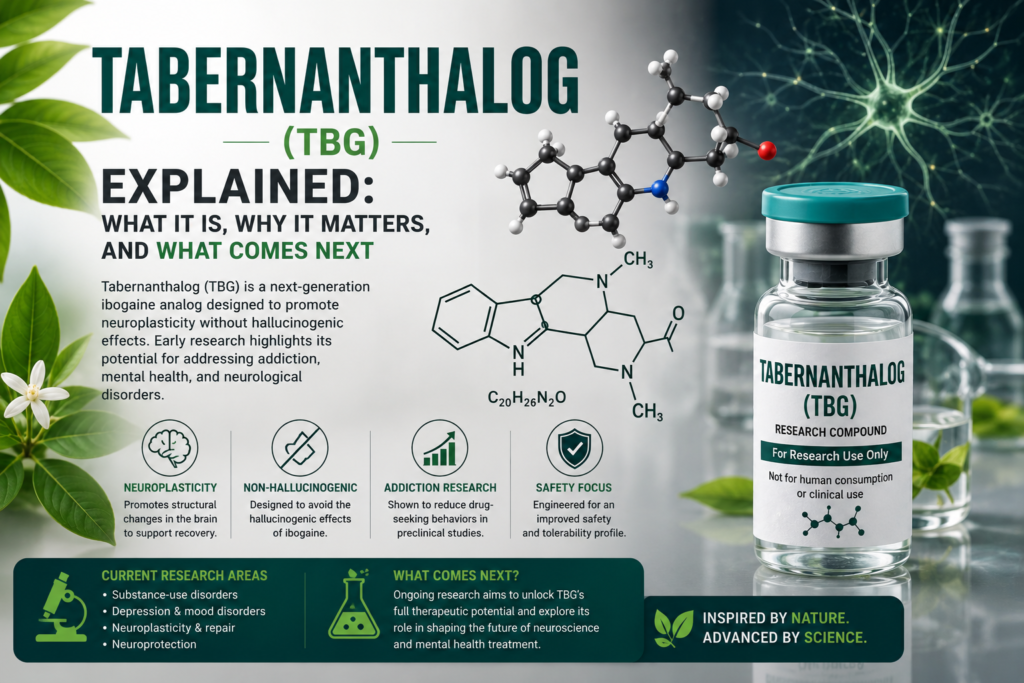
Tabernanthalog is a relatively new scientific term that has started to appear in discussions about next-generation treatments for conditions such as depression, substance use disorders, and other hard-to-treat mental health problems. It matters because it represents a broader shift in neuropsychiatry: researchers are no longer only asking whether a compound can change mood or behaviour in the short term, but whether it can drive longer-lasting changes in brain circuits that underpin those experiences.
To understand why tabernanthalog draws attention, it helps to recognise the context in which it emerged. Over the last decade, renewed scientific interest in certain psychoactive compounds has coincided with major unmet clinical need. Many people do not respond well to existing antidepressants, and relapse remains common across multiple mental health conditions. Meanwhile, some compounds associated with powerful, rapid changes in symptoms also come with practical barriers, including difficult experiences during treatment, safety concerns, and complex regulation. Tabernanthalog sits at the intersection of these pressures: it is part of an effort to retain potential therapeutic mechanisms while reducing features that make some compounds hard to use widely.
In clear terms, tabernanthalog is discussed as a designed compound inspired by iboga-derived science, intended to probe and potentially harness certain brain-changing properties without necessarily reproducing every effect of the original natural alkaloids. That ambition is simple to state and difficult to achieve. The important point for readers is that tabernanthalog is best understood as a research-driven attempt to separate “beneficial biological mechanisms” from “unwanted risk and complexity”, and then test whether that separation holds up in rigorous studies.
Defining tabernanthalog in Practical, Research-Friendly Terms: What Scientists Mean (and What They Do Not)
In the language of neuropharmacology, tabernanthalog is generally described as a synthetic analogue related to the chemistry of iboga alkaloids. The word itself signals intent: a “log” in this context points to a molecule designed to be similar enough to inform research questions, while different enough to potentially change the risk–benefit profile. Rather than framing tabernanthalog as a ready-made medicine, it is more accurate to think of it as a tool compound with therapeutic promise that still needs to be proven in people.
When researchers use the term tabernanthalog, they are typically referring to a specific structure that has been reported in preclinical work to influence neuronal growth and synaptic changes in ways that could be relevant to psychiatric treatment. Importantly, the term is not simply a rebranding of an existing medicine, and it should not be treated as a synonym for any established therapy. It is also not a guarantee of safety, efficacy, or suitability for self-experimentation. At this stage, tabernanthalog is best placed in the “active area of investigation” category.
One reason definitions matter is that the surrounding public conversation can move faster than the evidence. A precise, practical definition keeps expectations grounded: tabernanthalog is a lab-designed compound inspired by a natural-product lineage, proposed to engage brain plasticity mechanisms, with current evidence primarily coming from laboratory and animal studies rather than large human trials.
How tabernanthalog Relates to Iboga-Derived Science Without Repeating Its Risks and Limitations
Iboga-derived science refers to research inspired by alkaloids originating from the iboga plant, particularly compounds studied for their complex effects on mood, addiction-related behaviours, and perception. This area has been of interest because some observations suggest rapid, sometimes durable changes in addictive patterns and depressive symptoms. However, translating that interest into widely acceptable medical treatment has been challenged by safety concerns, variability of preparations, and the intensity of subjective experiences associated with certain compounds.
Tabernanthalog enters this picture as an attempt to learn from the most intriguing parts of the iboga-derived story while addressing barriers that make those original compounds difficult to develop. In principle, that means designing a molecule that can be manufactured consistently, dosed reliably, studied systematically, and potentially administered with fewer clinical complications. This is not a small ask: the iboga-related pharmacology is complex, and “simplifying” a compound may also remove effects that turned out to be central to any therapeutic impact.
A key scientific and clinical question is whether the most valuable outcomes linked to iboga-derived compounds depend on the acute subjective experience, or whether they can be driven primarily through downstream biological changes in brain circuits. Tabernanthalog is notable precisely because it is often discussed as a step towards testing that hypothesis. If a compound can promote beneficial circuit changes with less disruptive acute experience and a safer cardiovascular profile, it could broaden access and make controlled medical use more feasible. If it cannot, then the field learns something equally valuable: that subjective and biological effects may be more tightly linked than hoped.
What the Current State of Evidence Actually Shows: Promising Signals, Major Gaps, and How to Read Early Results
The current state of evidence around tabernanthalog is best described as early and mostly preclinical. In practical terms, that means the strongest claims should be limited to what has been observed in controlled laboratory settings and animal models. Preclinical studies can be enormously informative, especially when they combine behavioural outcomes with mechanistic measures such as synaptic markers, imaging proxies, or gene-expression patterns. They can also mislead if we treat them as direct predictors of what will happen in diverse human patients.
Why do early results often look exciting? Preclinical models are designed to detect signal. They control confounders tightly, use carefully selected subjects, and may focus on outcomes that map only partially onto real-world psychiatric illness. Depression, for example, is not a single biological state; it is a clinical syndrome with multiple pathways. Addiction is similarly complex, embedded in social context, trauma exposure, and learned behaviour across years. A compound that shifts certain neural markers or reduces a particular behavioural readout in rodents may still fail to show meaningful benefit in people, or it may help only a subset of patients.
At the same time, it would be unfair to dismiss preclinical work. The modern standard is not “animals prove it works” but “animals help justify the risk and cost of human trials, and help identify what to measure in those trials”. If tabernanthalog reliably produces changes consistent with enhanced synaptic remodelling, and if those changes correlate with improved behaviours in validated paradigms, that creates a rational basis for moving forward. The gap is that, until well-designed human studies are completed, we cannot confidently answer the questions most people care about: who it helps, how much, for how long, at what dose, and with what risks.
Why neuroplasticity research Is Central to tabernanthalog and the Wider Push for Faster-Acting Treatments
neuroplasticity research is one of the main reasons tabernanthalog has become a topic of interest. Neuroplasticity refers to the brain’s ability to change: to strengthen or weaken connections, form new synapses, prune old ones, and reorganise circuits in response to experience, learning, stress, or treatment. Many established psychiatric medicines influence neurotransmitters quickly but require weeks for noticeable clinical improvement, suggesting that downstream adaptation and circuit-level change may be where durable benefit actually lives.
In several modern lines of investigation, researchers are exploring whether certain compounds can accelerate or amplify plasticity in targeted ways. The logic is not simply “more plasticity is better”. Too much plasticity at the wrong time, or in the wrong circuits, could theoretically worsen anxiety, destabilise mood, or reinforce harmful learning. The aim is better framed as “use plasticity to reopen a window for change”, ideally paired with supportive care that guides that change in a healthy direction.
Tabernanthalog has been discussed as part of a “psychoplastogen” style approach, a label used in some scientific writing to describe compounds that may promote structural and functional neural plasticity. Within that frame, the central promise is not a daily symptom-suppressor, but a treatment that nudges the brain towards a more adaptable state, potentially allowing entrenched patterns of negative mood or compulsive behaviour to shift more rapidly. If this is the mechanism that matters, then neuroplasticity research becomes not a side topic but the core: it shapes dosing strategies, trial endpoints, and the type of psychotherapy or behavioural support that might most effectively pair with medication.
What depression treatment research Can Realistically Expect: Potential Advantages, Practical Constraints, and the Need for Careful Trials
depression treatment research is increasingly shaped by two realities: first, a substantial proportion of patients do not achieve sustained remission with existing options; second, speed matters. When depression is severe, waiting weeks for incremental improvement can be dangerous and deeply disruptive. Compounds that appear to act more rapidly have therefore become a major focus, alongside efforts to personalise treatment choices.
Tabernanthalog is discussed as a candidate that might, in theory, contribute to this “faster and longer-lasting” ambition by promoting circuit-level change rather than only transient neurotransmitter shifts. The hope is not merely to blunt symptoms for a day, but to reduce the grip of rigid negative thinking, anhedonia, and stress sensitivity over time. If plasticity is the pathway, then an ideal outcome would be sustained improvement after limited dosing, potentially reducing the burden of daily medication and ongoing side effects.
Yet depression treatment research must be especially cautious with early-stage compounds, because the history of psychiatry includes many interventions that looked plausible mechanistically but failed in real-world populations. Key constraints include heterogeneity (different biological and psychological drivers can produce similar depressive symptoms), co-existing anxiety or trauma, physical health factors, and medication interactions. It is also critical to distinguish between short-term mood elevation and meaningful remission. A compound that temporarily increases energy without improving core depressive cognition could, in some patients, increase agitation or risk-taking.
Could tabernanthalog Become a Widely Used mental health drug? The Development Pathway and the Real-World Barriers
The phrase mental health drug can imply something already on pharmacy shelves, but tabernanthalog is not there. To become a widely used mental health drug, a compound must pass through multiple layers of scrutiny: safety pharmacology, dosing studies, early human trials, larger efficacy trials, and post-marketing surveillance if approved. It must also be manufacturable to high standards, stable, and deliverable in clinical environments that range from specialist centres to everyday services.
Several barriers are predictable. First is safety. Any compound in this scientific family will be evaluated closely for cardiovascular effects, interactions with other medicines, and potential neurotoxicity. Even rare serious adverse events can halt development if the intended population is large. Second is tolerability and acceptability. Treatments that require extensive monitoring, complex dosing protocols, or prolonged clinical supervision can be life-changing for some patients yet remain difficult to scale. Third is misuse potential. Regulators and clinicians will want to understand whether tabernanthalog has abuse liability, whether it alters judgement acutely, and how it behaves when combined with alcohol or other substances.
There is also a practical barrier that is less glamorous but often decisive: demonstrating clear advantage over existing care. It is not enough to show “some improvement”. A new mental health drug must either help patients who do not respond to current treatments, work faster, have fewer side effects, or deliver more durable benefit. Ideally, it should do several of these at once. The economic and service-delivery environment also matters; if a treatment requires extensive clinic time, it may be limited to specific settings unless the benefits are substantial and consistent.
Mechanism Matters: Receptors, Circuits, and Why “One Target” Thinking May Not Apply
In neuropsychiatry, there is a long-running temptation to identify a single receptor or neurotransmitter system as “the answer”. In reality, many compounds with meaningful psychiatric effects interact with multiple systems, sometimes directly and sometimes through downstream signalling cascades. The iboga-derived lineage is often described as pharmacologically complex, and tabernanthalog is discussed in that broader context.
For readers trying to make sense of mechanism claims, it is useful to separate three layers. The first layer is receptor binding: which molecular targets the compound interacts with. The second layer is intracellular signalling: what those interactions cause cells to do, including gene expression and synaptic protein production. The third layer is circuit function: how networks involved in mood regulation, reward learning, threat detection, and cognitive control change over time.
Tabernanthalog’s interest is largely driven by the idea that it may influence the second and third layers in ways that promote healthier patterns of activity. The research challenge is to show that these changes are not only measurable but also beneficial, durable, and controllable. A mechanism that increases plasticity could be helpful when paired with supportive interventions, but it could also be unpredictable if delivered without adequate clinical structure. This is why “mechanism matters” is not an academic slogan here; it directly affects how a future treatment would be administered, monitored, and integrated into care.
Safety, Ethics, and Oversight: Why the “Why It Matters” Includes More Than Efficacy
Any discussion of an emerging neuropsychiatric compound should treat safety and ethics as central, not as footnotes. This is especially true for compounds inspired by natural-product traditions that have both scientific interest and strong public narratives. Tabernanthalog’s development, if it continues, will be shaped as much by careful risk management as by therapeutic ambition.
Safety is not only about acute adverse events; it includes longer-term effects on sleep, cognition, emotional regulation, and cardiovascular health. It includes interaction risks for people taking multiple medicines, which is common in psychiatry and primary care. It also includes the possibility of rare but serious outcomes that only appear when large numbers of people have been treated.
Ethics includes informed consent, especially if a compound has perceptual or dissociative effects at some doses. It includes equitable access, so that promising treatments do not become confined to a narrow set of private clinics. It includes responsible communication, so that vulnerable patients are not led to believe that early findings guarantee personal benefit. And it includes trial design that respects participants: clear rescue protocols, robust follow-up, and transparency about uncertainties.
Designing the Next Studies: What Researchers Need to Prove, Measure, and Compare
When people ask “what comes next” for tabernanthalog, the most meaningful answer is “better evidence”. That does not only mean more studies; it means more informative studies. The next wave of research, ideally, clarifies dose–response relationships, characterises short- and long-term safety, and tests efficacy in clearly defined clinical populations.
Study design questions are not just technicalities. They determine whether the results can be trusted and used. For example, if the hypothesised benefit involves a window of enhanced plasticity, then the timing of outcome measures matters: researchers may need to assess not only immediate symptom change but also learning, habit change, and relapse rates over time. Similarly, if pairing with psychotherapy is likely to amplify benefit, then trials should not treat therapy as an optional extra; they should specify what supportive care is provided, and evaluate how it interacts with the medicine.
Comparators matter too. A trial that shows tabernanthalog is better than placebo is informative, but a trial that shows it is meaningfully better than an existing evidence-based option is far more impactful for patients and clinicians. The field will also benefit from biomarker strategies that can identify responders. If tabernanthalog helps a subset of people with a particular neurobiological profile, discovering that early could prevent years of trial-and-error prescribing.
What Comes Next for tabernanthalog Explained: The Key Questions That Still Need Answers
Tabernanthalog is drawing attention because it sits on a compelling idea: that we might be able to design medicines that promote beneficial brain change while reducing burdens that have limited earlier compounds. Whether that idea becomes a practical reality depends on questions that are still open.
First, does tabernanthalog produce clinically meaningful benefit in humans, not only changes in laboratory measures? Second, how durable are any benefits, and what follow-up care is needed to maintain them? Third, what is the safety profile across different ages, physical health conditions, and co-prescribed medicines? Fourth, does it meaningfully reduce relapse in substance use disorders or improve functioning in depression beyond what current best practice can achieve?
There are also questions about delivery. Would this be a medicine taken at home, or administered in clinics with monitoring? Would it require psychological support to guide the period of increased adaptability? How would health systems integrate it without widening inequality in access? These are not speculative worries; they are the real determinants of whether a promising compound becomes a useful treatment rather than an interesting footnote.
